
Free Article


DO ObseRve (DOOR)
A Practical Social Observation Strategy for Managing Social Transitions
Kari Zweber Palmer, MA, CCC-SLP, Ryan Hendrix, MS, CCC-SLP, Michelle Garcia Winner, MA, CCC-SLP, Pamela Crooke, PhD, CCC-SLP
Summary:
- Doors act as natural visual cues that show kids when a situation and its expectations are about to change.
- The DO ObseRve strategy encourages children to pause at a doorway to look, listen, and make smart guesses before entering a new space.
- A free DO ObseRve thinksheet is ready to download and use to support smoother transitions at school, at home, or out in the community.
As we prepare for a new school year, we’ve been thinking about the ways in which we can get ourselves, our families, and our clients set up for the changes ahead. And these thoughts keep centering on one thing: doors. Doors?! Yes, doors. Let’s explore why.
Everything we do socially starts with observation, or what we would call thinking with your eyes. What we notice and how we make sense of that is key to navigating new situations. Therefore, it is critical to spend time exploring social observation because it’s a foundational first step in teaching social competencies.
But how do doors fit into all of this?
Doors define spaces. Imagine walking into a school. You’ll pass through a main entrance and most likely see more…doors. Doors that separate the hallway from a classroom or the main office from the entryway. Doors in between the hallway and gym or cafeteria. Every time you pass through a door, the situation changes. And when the situation changes, so do the expectations and choices in that space.
Doors are a visual cue that the situation is changing. When you see a door, think DO ObseRve. Let’s take a look at the DOOR thinksheet visual below. Before we enter a situation, we can imagine what it will be like. We can anticipate based on our previous experiences and knowledge about the situation. For example, before stepping though the classroom door, we can imagine what it will be like. We can think to ourselves, where am I going (classroom), who might be there (teachers, students), and what might be happening (Morning work? Unpacking backpacks?) This gives us a framework for what happens next—the actual observation. After passing through the door, pause and observe. This is called thinking with our eyes. We also use our ears & brain to make a smart guess about what is going on in this new situation: What do you see? What do you hear? What do you know? This smart guess helps us to navigate the social situation we are now in.
Download the DO ObseRve (DOOR) Thinksheet
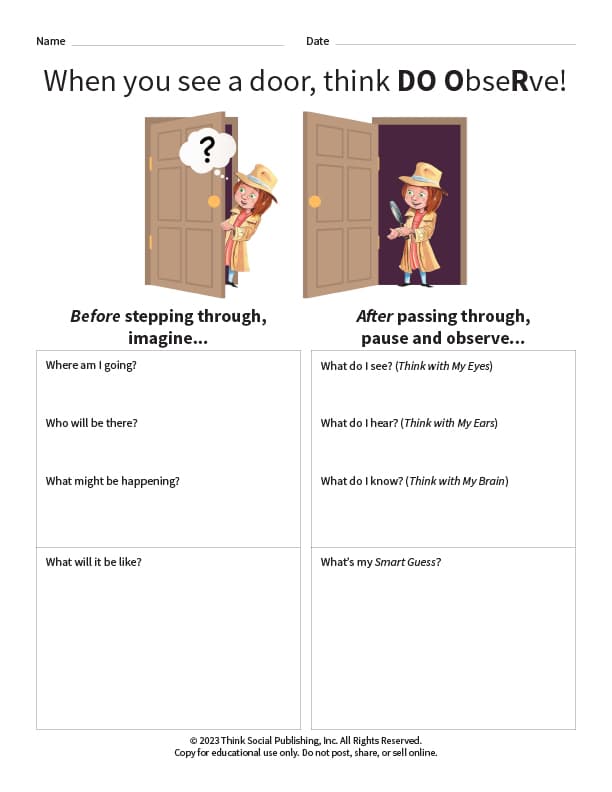
We pass through doorways every day without really paying attention to the transition. Consider using this handy visual thinksheet to help support students in making these transitions across their day. Also, keep in mind this simple strategy can be used in homes and the community. Every time you see a door, think DO ObseRve!
Thanks for reading! Join our community and be the first to hear about our latest products, articles, and more!